> ## Documentation Index
> Fetch the complete documentation index at: https://docs.caplena.com/llms.txt
> Use this file to discover all available pages before exploring further.
# Customizing Report
> Learn how to structure, customize, and present your Caplena report.
Caplena reports are designed to make insight-building simple, structured, and powerful. This guide explains everything you need to know to build, structure, and customize reports in Caplena.
## The Core Concept: How Reports Are Structured
Every report in Caplena has two layers:
* **Report Master** – where you build the structure
* **Views** – different perspectives on top of that structure
Let's walk through each one.
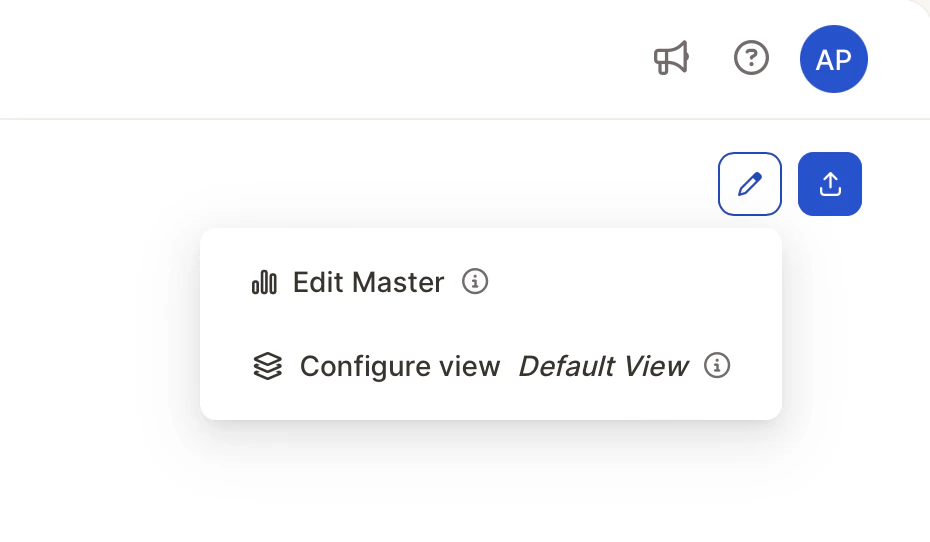 ## Report Master: Where You Build the Report
The **Report Master** is the blueprint of your report. This is where you build and edit the *actual content* of your report — what appears, how it's structured, and how the story flows.
In the Master, you can:
* Add / remove / rename **Sections**
* Add and arrange **Insight Elements**
* Reorder anything via drag-and-drop
* Adjust layout and structure
* Build Segments
## Report Master: Where You Build the Report
The **Report Master** is the blueprint of your report. This is where you build and edit the *actual content* of your report — what appears, how it's structured, and how the story flows.
In the Master, you can:
* Add / remove / rename **Sections**
* Add and arrange **Insight Elements**
* Reorder anything via drag-and-drop
* Adjust layout and structure
* Build Segments
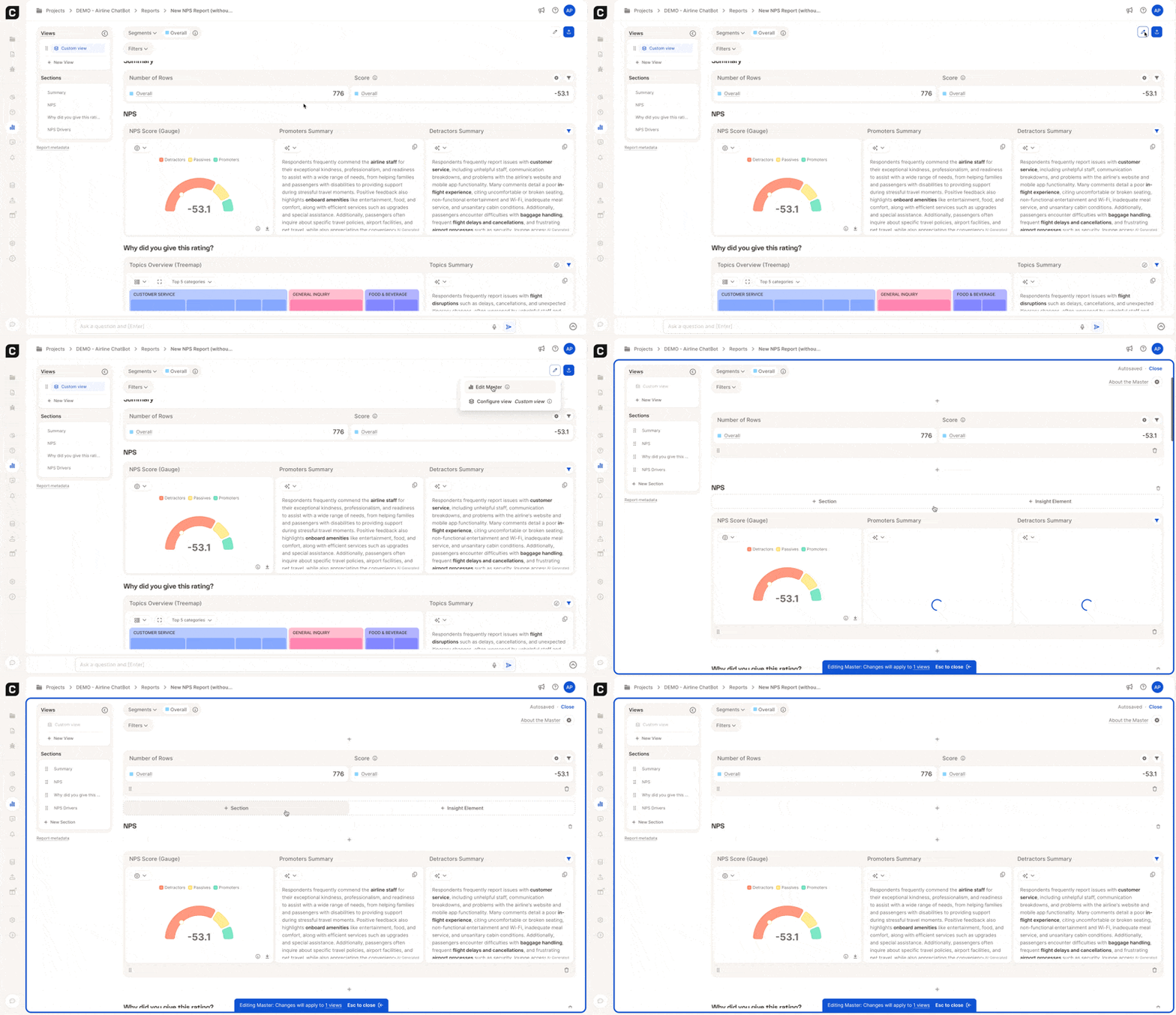 Any change you make here automatically updates every View. This keeps your report consistent, clean, and easy to maintain — no version drift, no duplicates.
**Use the Report Master when you want to change the content or structure of the report.**
## Views: Tailored Perspectives for Your Audience
Views let you create different angles on top of the same structure.
A **View** is a perspective where you can:
* Apply or lock local filters
* Choose specific segments
* Share a single View without sharing the entire report
Any change you make here automatically updates every View. This keeps your report consistent, clean, and easy to maintain — no version drift, no duplicates.
**Use the Report Master when you want to change the content or structure of the report.**
## Views: Tailored Perspectives for Your Audience
Views let you create different angles on top of the same structure.
A **View** is a perspective where you can:
* Apply or lock local filters
* Choose specific segments
* Share a single View without sharing the entire report
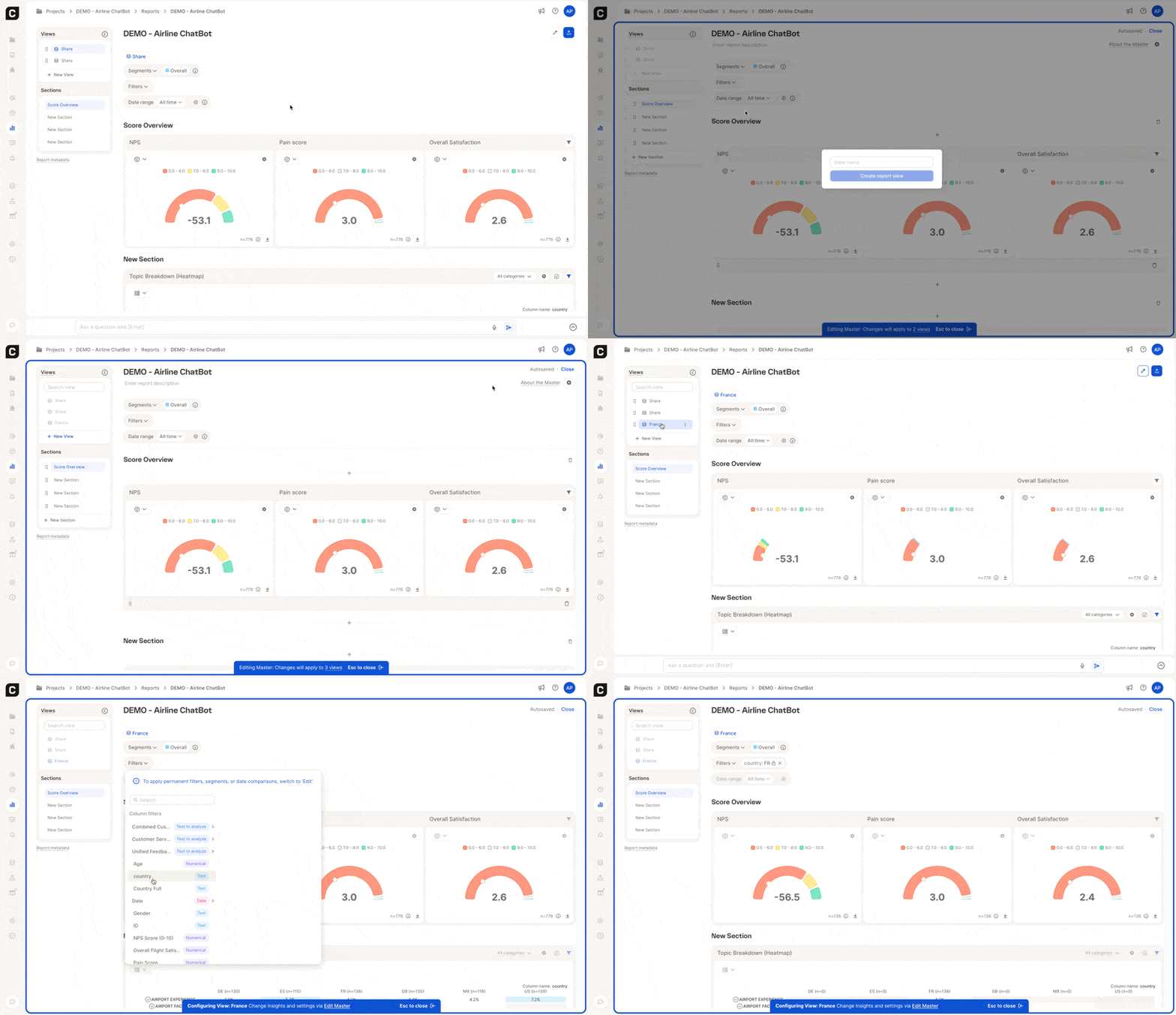 Views allow you to tailor insights for different stakeholders, teams, or themes, without modifying the underlying structure.
Common examples:
* **By region:** DACH, North America
* **By segment:** New vs. returning customers
* **By feedback type:** Detractors, negative sentiment
* **By product/channel:** Mobile app, checkout flow
* **By time period:** Pre-/post-launch, last 30 days
* **By stakeholder:** Leadership summary, Product view
Views do not change the structure. Sections, insights, and layout always remain controlled by the Master.
Use Views when you want to customize **what data** appears, not **how the report is built.**
## Sections: Organize Your Report
Sections help you break down complex data into manageable chunks, making your report easier to read and understand.
Views allow you to tailor insights for different stakeholders, teams, or themes, without modifying the underlying structure.
Common examples:
* **By region:** DACH, North America
* **By segment:** New vs. returning customers
* **By feedback type:** Detractors, negative sentiment
* **By product/channel:** Mobile app, checkout flow
* **By time period:** Pre-/post-launch, last 30 days
* **By stakeholder:** Leadership summary, Product view
Views do not change the structure. Sections, insights, and layout always remain controlled by the Master.
Use Views when you want to customize **what data** appears, not **how the report is built.**
## Sections: Organize Your Report
Sections help you break down complex data into manageable chunks, making your report easier to read and understand.
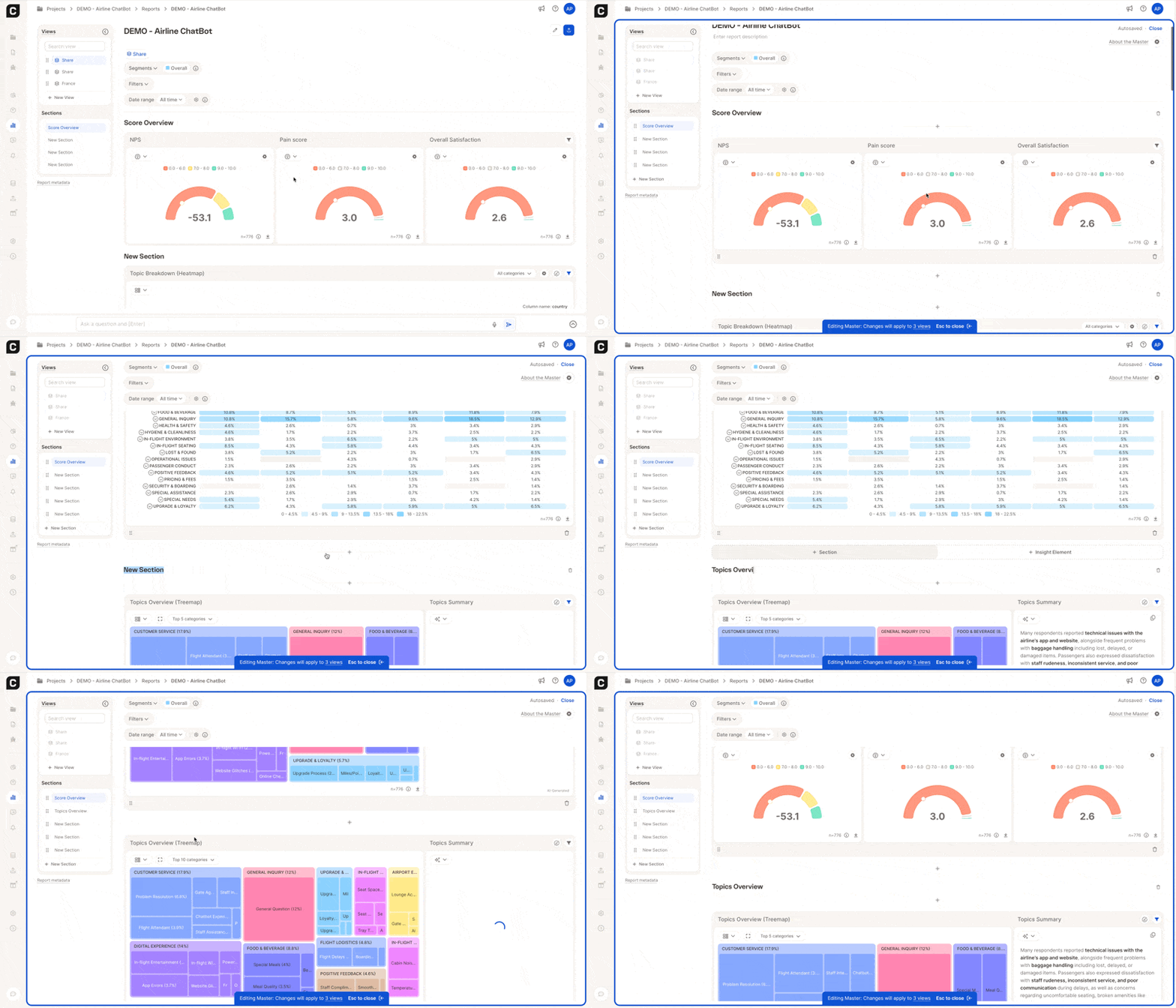 **How to Add a Section:**
1. In **Edit Mode**, click **+ Add New Section**.
2. Give your section a name (e.g., *"NPS Breakdown"*, *"Sentiment by Product"*).
3. Add visualizations, summaries, or custom text.
**Benefits:**
* **Better Organization** — Keep related insights grouped together.
* **Improved Readability** — Help readers focus on one topic at a time.
* **Drag-and-Drop Order** — Rearranging sections is as simple as dragging them in the side panel.
## Insight Elements: Visualize What Matters
Insight Elements are pre-built components that let you analyze and display your data in a powerful, digestible format.
**How to Add a Section:**
1. In **Edit Mode**, click **+ Add New Section**.
2. Give your section a name (e.g., *"NPS Breakdown"*, *"Sentiment by Product"*).
3. Add visualizations, summaries, or custom text.
**Benefits:**
* **Better Organization** — Keep related insights grouped together.
* **Improved Readability** — Help readers focus on one topic at a time.
* **Drag-and-Drop Order** — Rearranging sections is as simple as dragging them in the side panel.
## Insight Elements: Visualize What Matters
Insight Elements are pre-built components that let you analyze and display your data in a powerful, digestible format.
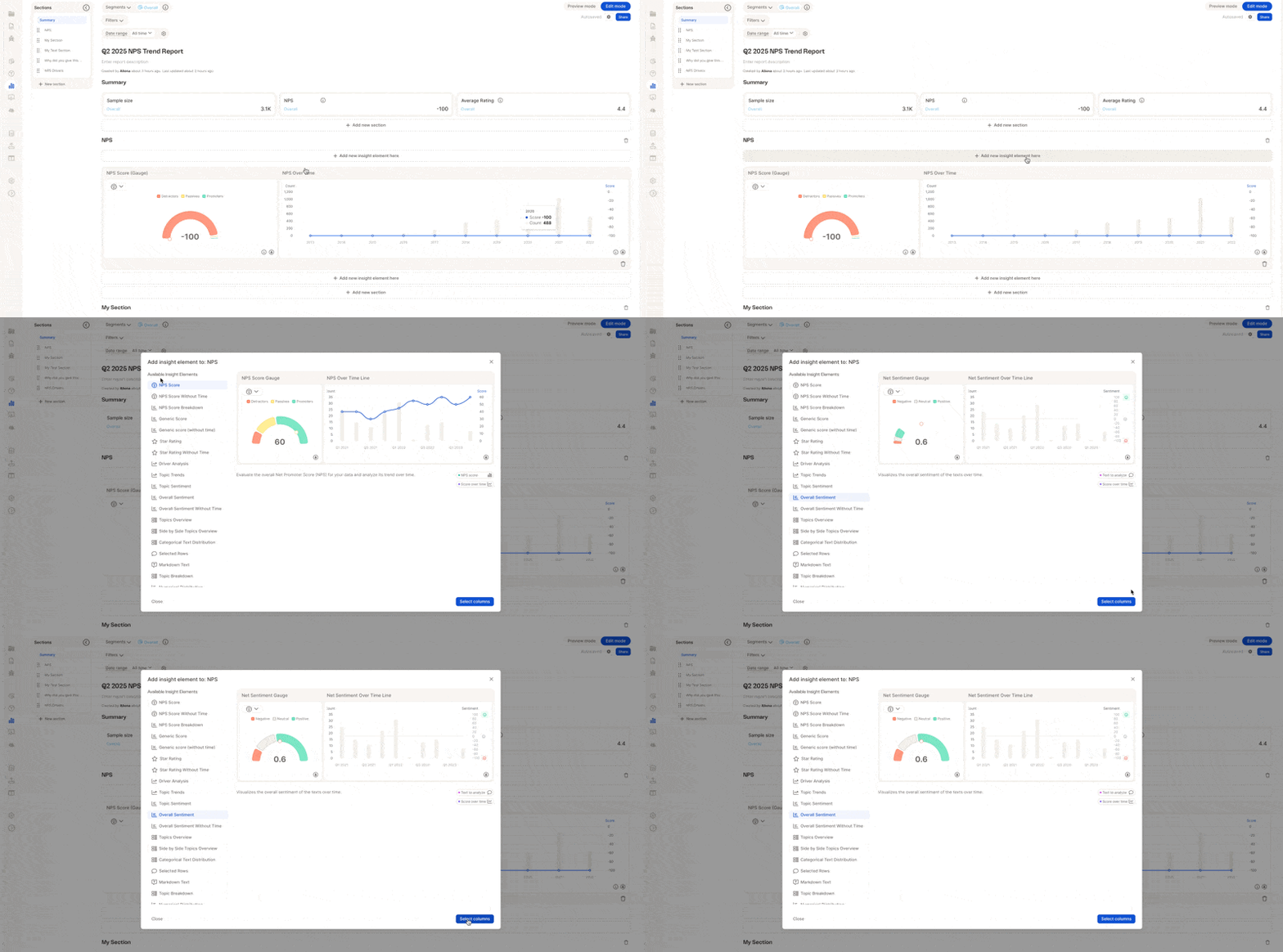 **Available Elements:**
* **NPS & Ratings** — Show Net Promoter Scores, star ratings, and score distributions.
* **Trends & Drivers** — Reveal what's impacting sentiment over time.
* **Sentiment Analysis** — Show overall or category-specific sentiment.
* **Topic Insights** — Break down feedback into themes or categories.
**How to Add an Insight:**
1. In Edit Mode, choose an insight type from the left panel.
2. Review its preview and purpose.
3. Click **Select Columns** to map the correct data fields.
4. The insight will be added to the current section.
## Filters & Segments: Focus Your Analysis
Caplena's **Filters** and **Segments** let you dive deeper into your data by zooming in on what's most relevant, whether that's a specific brand, region, or time frame.
**Filters**
Use filters to narrow your data view:
* **By Brand** — Compare customer experiences across products.
* **By Country** — Identify regional differences.
* **By Rating** — Focus on 1–2 star reviews to uncover pain points.
**Available Elements:**
* **NPS & Ratings** — Show Net Promoter Scores, star ratings, and score distributions.
* **Trends & Drivers** — Reveal what's impacting sentiment over time.
* **Sentiment Analysis** — Show overall or category-specific sentiment.
* **Topic Insights** — Break down feedback into themes or categories.
**How to Add an Insight:**
1. In Edit Mode, choose an insight type from the left panel.
2. Review its preview and purpose.
3. Click **Select Columns** to map the correct data fields.
4. The insight will be added to the current section.
## Filters & Segments: Focus Your Analysis
Caplena's **Filters** and **Segments** let you dive deeper into your data by zooming in on what's most relevant, whether that's a specific brand, region, or time frame.
**Filters**
Use filters to narrow your data view:
* **By Brand** — Compare customer experiences across products.
* **By Country** — Identify regional differences.
* **By Rating** — Focus on 1–2 star reviews to uncover pain points.
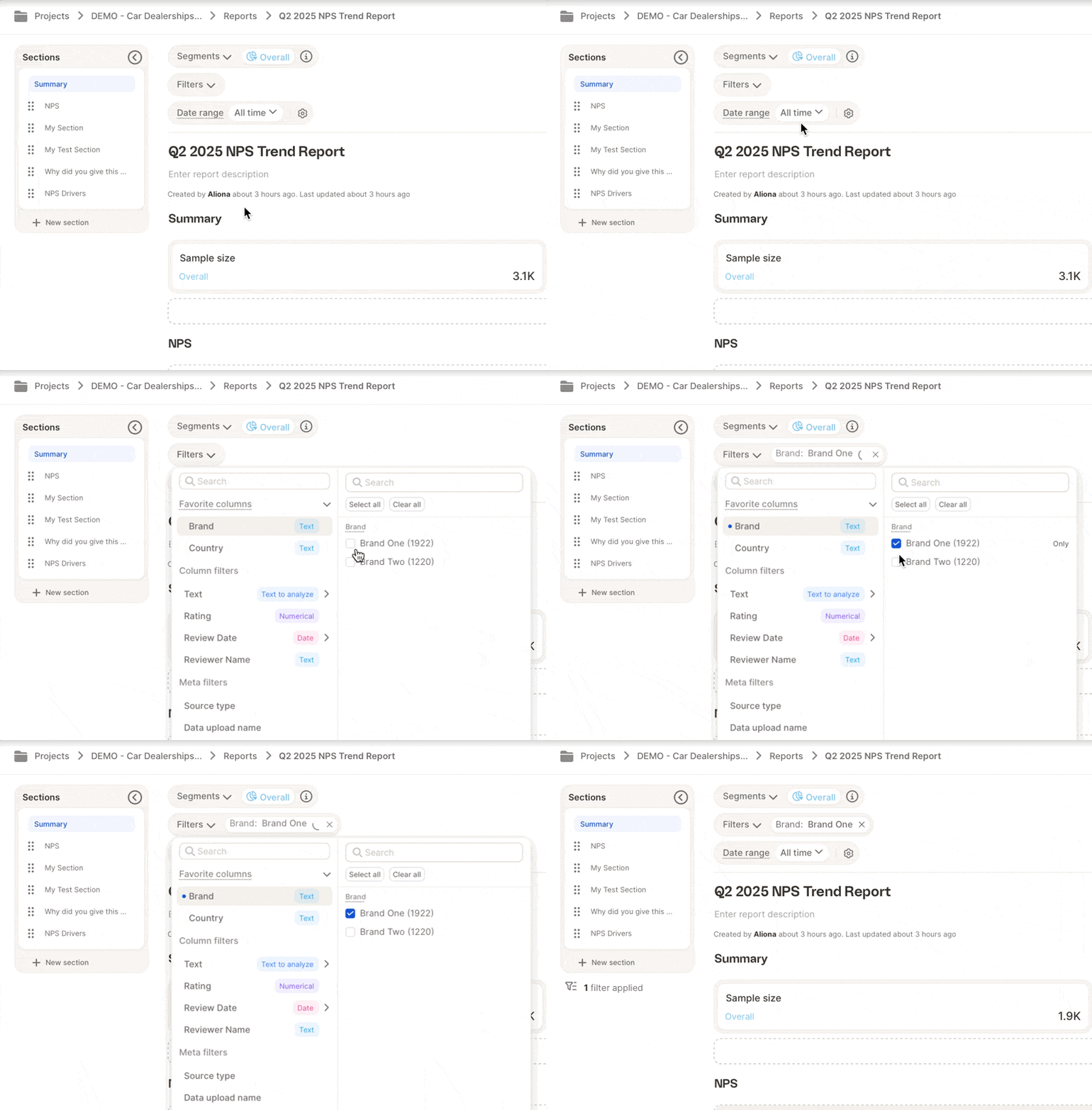 **Example:** Filter for 1–2 star reviews from Germany to understand local pain points.
**Creating Segments**
You can create segments in two ways — using AI or manually.
**AI-assisted segment creation**
In **Edit Master**, select the **Overall** segment and click **Edit**. You'll see the option to describe the segment you want in plain language, for example, *"Create segments by country."* Caplena will look at the additional variables in your dataset and automatically generate the relevant segments.
**Manual segment creation**
Prefer to build segments yourself? Select a variable (e.g., *Gender*), choose the values you want, and create all segments in one go.
**Managing segments**
Once created, you can:
* **Change the color** of any segment — colors are assigned automatically, but you can customize them to match your preferences or branding
* **Control visibility** in specific views
* **Duplicate** a segment if you need a variation of it
Segments are great for comparing different data cuts side by side, like Brand A vs. Brand B.
## Date Range Filter
The **Date Range** filter helps you examine how key metrics, customer sentiment, or feedback trends evolve over time. It's especially powerful when tracking changes before and after events like product updates, marketing campaigns, or customer service improvements.
**Example:** Filter for 1–2 star reviews from Germany to understand local pain points.
**Creating Segments**
You can create segments in two ways — using AI or manually.
**AI-assisted segment creation**
In **Edit Master**, select the **Overall** segment and click **Edit**. You'll see the option to describe the segment you want in plain language, for example, *"Create segments by country."* Caplena will look at the additional variables in your dataset and automatically generate the relevant segments.
**Manual segment creation**
Prefer to build segments yourself? Select a variable (e.g., *Gender*), choose the values you want, and create all segments in one go.
**Managing segments**
Once created, you can:
* **Change the color** of any segment — colors are assigned automatically, but you can customize them to match your preferences or branding
* **Control visibility** in specific views
* **Duplicate** a segment if you need a variation of it
Segments are great for comparing different data cuts side by side, like Brand A vs. Brand B.
## Date Range Filter
The **Date Range** filter helps you examine how key metrics, customer sentiment, or feedback trends evolve over time. It's especially powerful when tracking changes before and after events like product updates, marketing campaigns, or customer service improvements.
 **Date as a Filter**
You can add a **Date filter** to narrow down which reviews or responses to include in your analysis.
**How to find it:** Go to **Filters → Review Date**. You can then choose between two modes:
* **Rolling range** — Automatically updates over time (e.g., "Last 12 months," "Last quarter," "Last 30 days").
* **Static range** — Lets you manually pick exact start and end dates from the calendar.
**Date as a Filter**
You can add a **Date filter** to narrow down which reviews or responses to include in your analysis.
**How to find it:** Go to **Filters → Review Date**. You can then choose between two modes:
* **Rolling range** — Automatically updates over time (e.g., "Last 12 months," "Last quarter," "Last 30 days").
* **Static range** — Lets you manually pick exact start and end dates from the calendar.
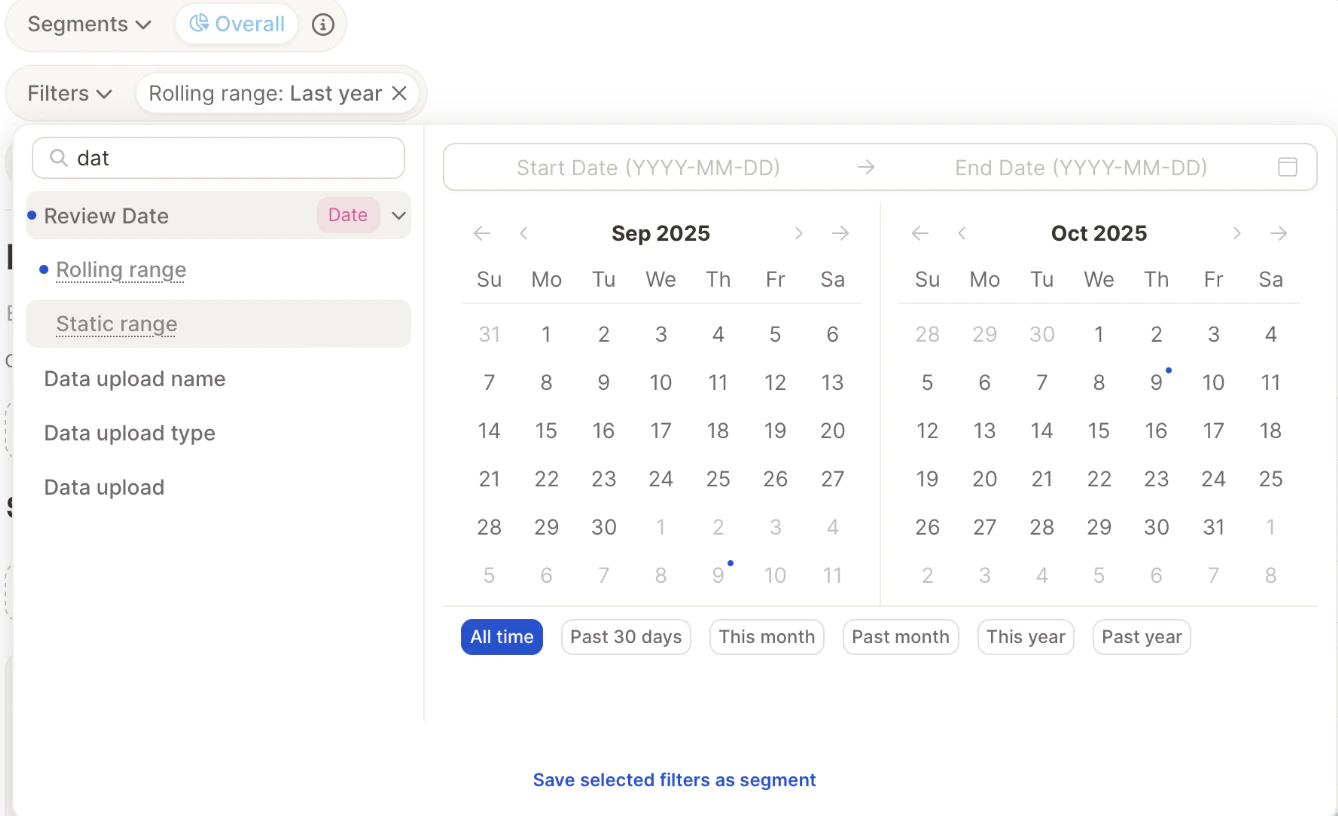 Use "Rolling range" if you want your dashboard or report to stay up to date automatically.
**Comparing Date Ranges**
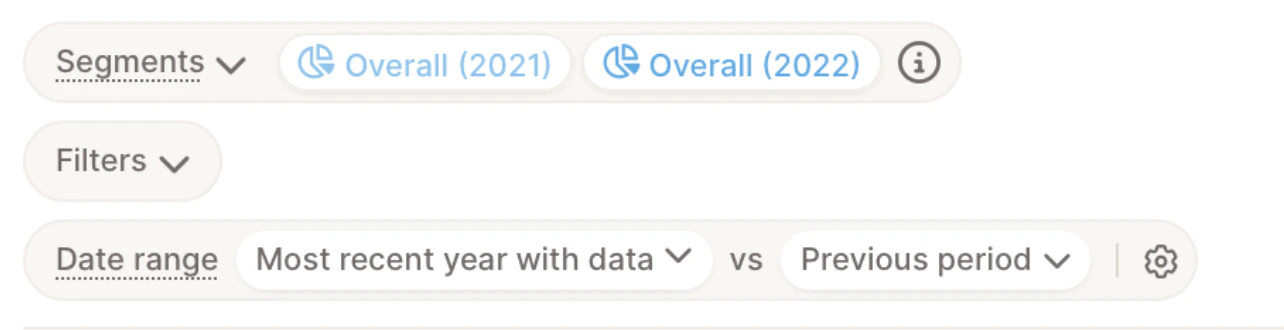
You can use **Date range** and **Comparison** settings to visualize changes over time and compare key metrics between different periods.
**Selecting a Date Range**
Under **Date range**, choose how far back your data should go. You can pick from:
* **All time** – includes your entire dataset.
* **Fixed timeframes** such as *Last 7 days*, *Last month*, or *Last year*.
* **Dynamic ranges** like *Most recent week/month/quarter/year with data*, which automatically adjust based on when new data comes in.
* **Custom date range** – manually select start and end dates.
Use "Rolling range" if you want your dashboard or report to stay up to date automatically.
**Comparing Date Ranges**
You can use **Date range** and **Comparison** settings to visualize changes over time and compare key metrics between different periods.
**Selecting a Date Range**
Under **Date range**, choose how far back your data should go. You can pick from:
* **All time** – includes your entire dataset.
* **Fixed timeframes** such as *Last 7 days*, *Last month*, or *Last year*.
* **Dynamic ranges** like *Most recent week/month/quarter/year with data*, which automatically adjust based on when new data comes in.
* **Custom date range** – manually select start and end dates.
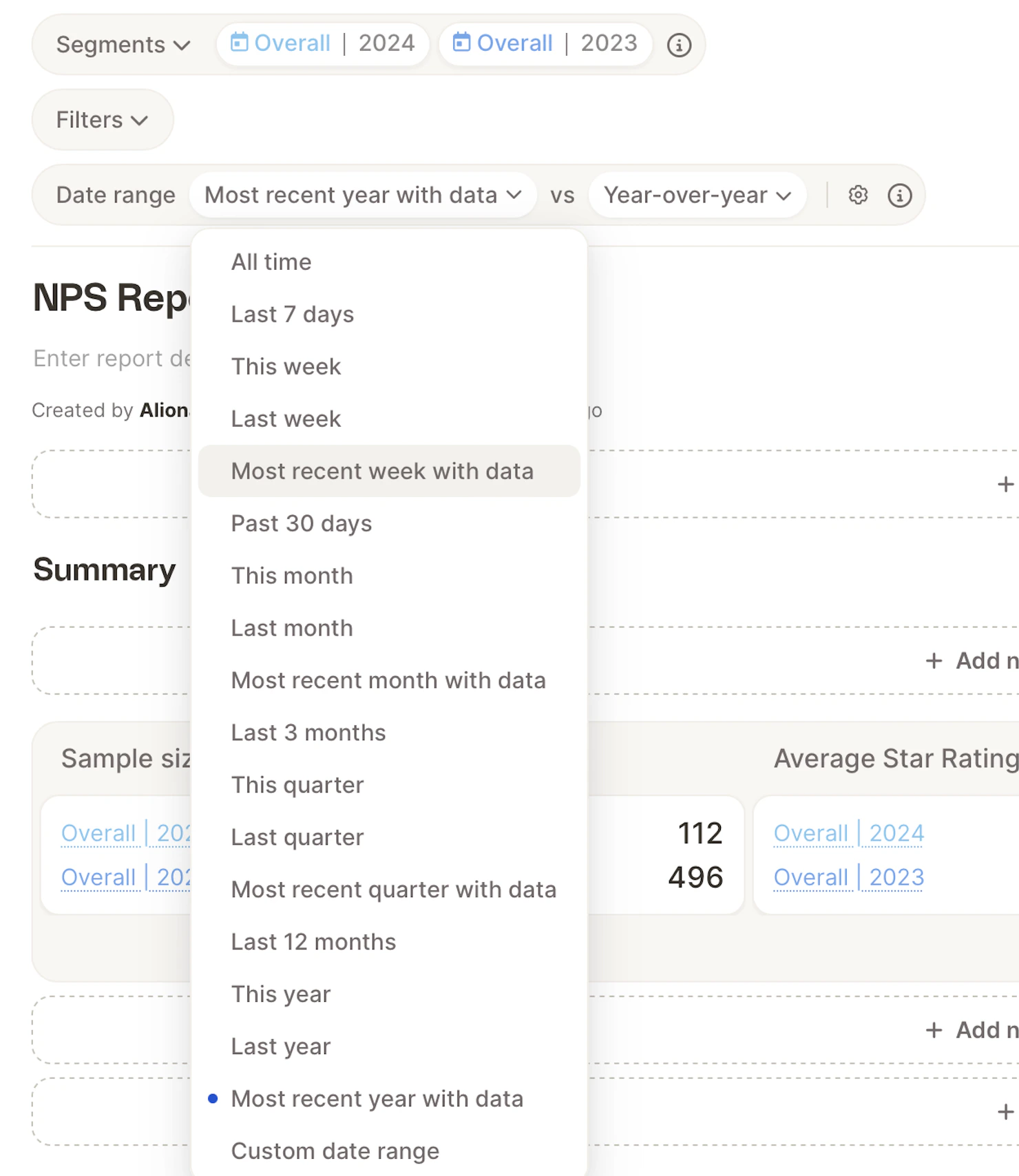 "Most recent year with data" is a great option for ongoing projects that update automatically as new feedback arrives.
**Choosing Intervals**
The **Date aggregation** (or interval) setting defines how results are grouped over time. Each data point on your chart represents one interval — so choosing the right granularity has a big impact on how trends are read.
"Most recent year with data" is a great option for ongoing projects that update automatically as new feedback arrives.
**Choosing Intervals**
The **Date aggregation** (or interval) setting defines how results are grouped over time. Each data point on your chart represents one interval — so choosing the right granularity has a big impact on how trends are read.
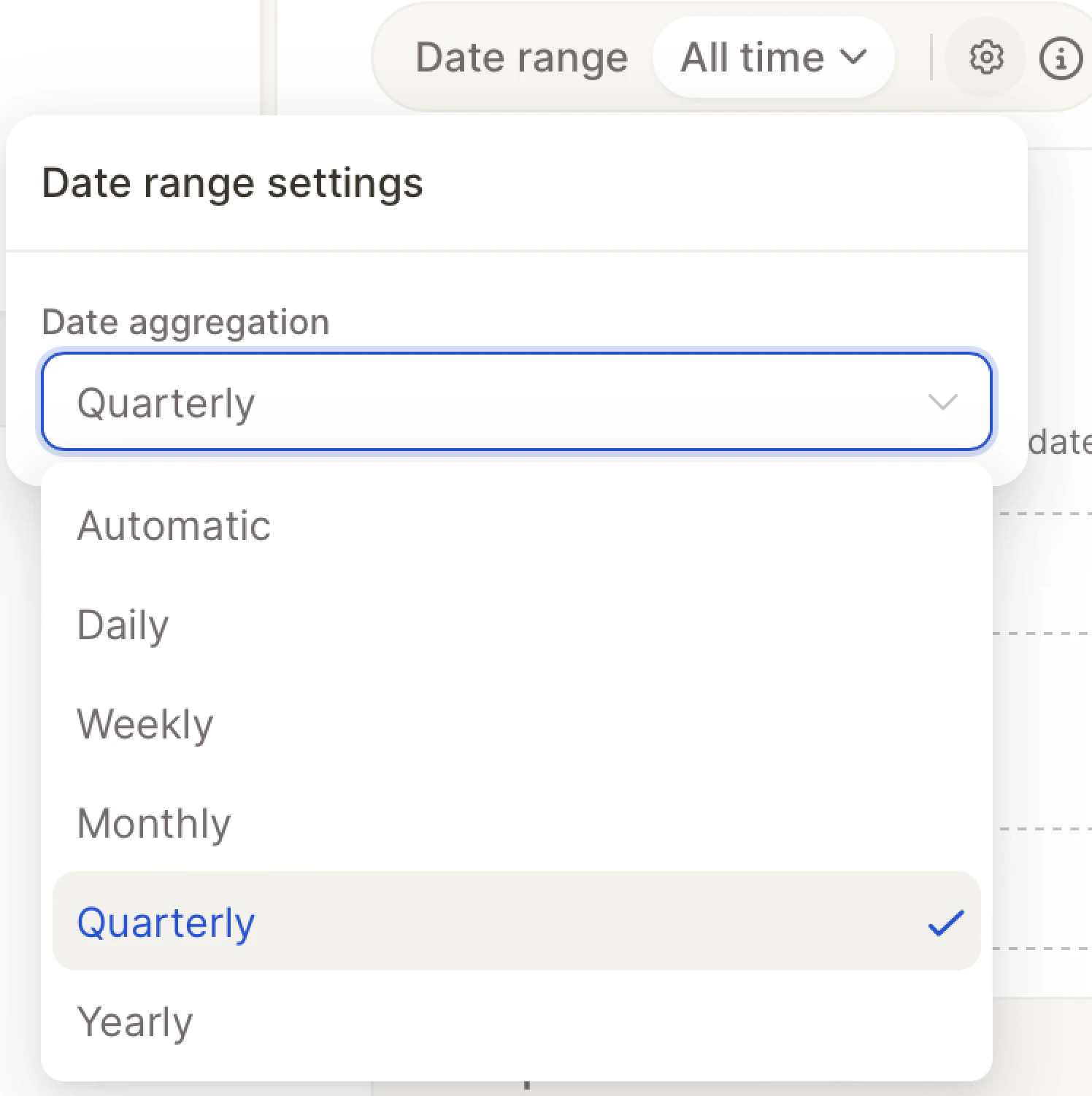 **Available intervals**
| Interval | Best for |
| ----------- | -------------------------------------------------------------------------------------------- |
| **Day** | Short windows, tracking immediate reactions to launches, campaigns, or incidents. |
| **Week** | Useful for spotting weekly patterns without the noise of daily variation. |
| **Month** | Balances detail with readability and aligns with business reporting cycles. |
| **Quarter** | Ideal for business reporting cycles or when you want to compare performance across quarters. |
| **Year** | Long-running projects with multiple years of feedback. |
**How to choose the right interval**
* **Match the interval to your date range.** A daily interval over two years produces a crowded, unreadable chart; a yearly interval over three months gives you a single bar.
* **Consider data volume per interval.** If a single day only has a handful of responses, daily aggregation will look spiky and unreliable. Move up to weekly or monthly so each point reflects a meaningful sample.
* **Align with how the business reports.** If stakeholders track results monthly or by quarter, mirror that interval so your report drops straight into existing reviews.
* **Use shorter intervals to investigate, longer intervals to communicate.** Drill down to daily or weekly when diagnosing a spike, then switch back to monthly or quarterly for the shareable view.
Changing the interval doesn't change your underlying data or filters, only how points are grouped on the chart. You can switch back and forth freely while exploring.
**Available intervals**
| Interval | Best for |
| ----------- | -------------------------------------------------------------------------------------------- |
| **Day** | Short windows, tracking immediate reactions to launches, campaigns, or incidents. |
| **Week** | Useful for spotting weekly patterns without the noise of daily variation. |
| **Month** | Balances detail with readability and aligns with business reporting cycles. |
| **Quarter** | Ideal for business reporting cycles or when you want to compare performance across quarters. |
| **Year** | Long-running projects with multiple years of feedback. |
**How to choose the right interval**
* **Match the interval to your date range.** A daily interval over two years produces a crowded, unreadable chart; a yearly interval over three months gives you a single bar.
* **Consider data volume per interval.** If a single day only has a handful of responses, daily aggregation will look spiky and unreliable. Move up to weekly or monthly so each point reflects a meaningful sample.
* **Align with how the business reports.** If stakeholders track results monthly or by quarter, mirror that interval so your report drops straight into existing reviews.
* **Use shorter intervals to investigate, longer intervals to communicate.** Drill down to daily or weekly when diagnosing a spike, then switch back to monthly or quarterly for the shareable view.
Changing the interval doesn't change your underlying data or filters, only how points are grouped on the chart. You can switch back and forth freely while exploring.