

- Analyze your data — ask open-ended questions and dig into themes, sentiment, and drivers
- Create and edit Smart Columns from a plain-language description, no formulas needed
- Critique and fix topic assignment quality — a built-in capability (the Topic Critique Agent) reachable from the magic-wand icon next to the AI Score
- Ask product and how-to questions about Caplena itself, with citations to the docs
- Work from Slack or Microsoft Teams, no tab switching needed
- Share it with report recipients, scoped to their filtered data only
Why use Agent?
It streamlines data analysis, enabling faster decisions and more customer-focused strategies to improve satisfaction and efficiency.How to access Agent
You can open Agent from three places in Caplena:- Agent tab — click the dedicated tab in the left sidebar to open the full Agent interface
- Project overview — use the chat input at the bottom of the project overview page to ask questions directly
- Reports — access it from within any report to ask questions in the context of that report’s data
The interface
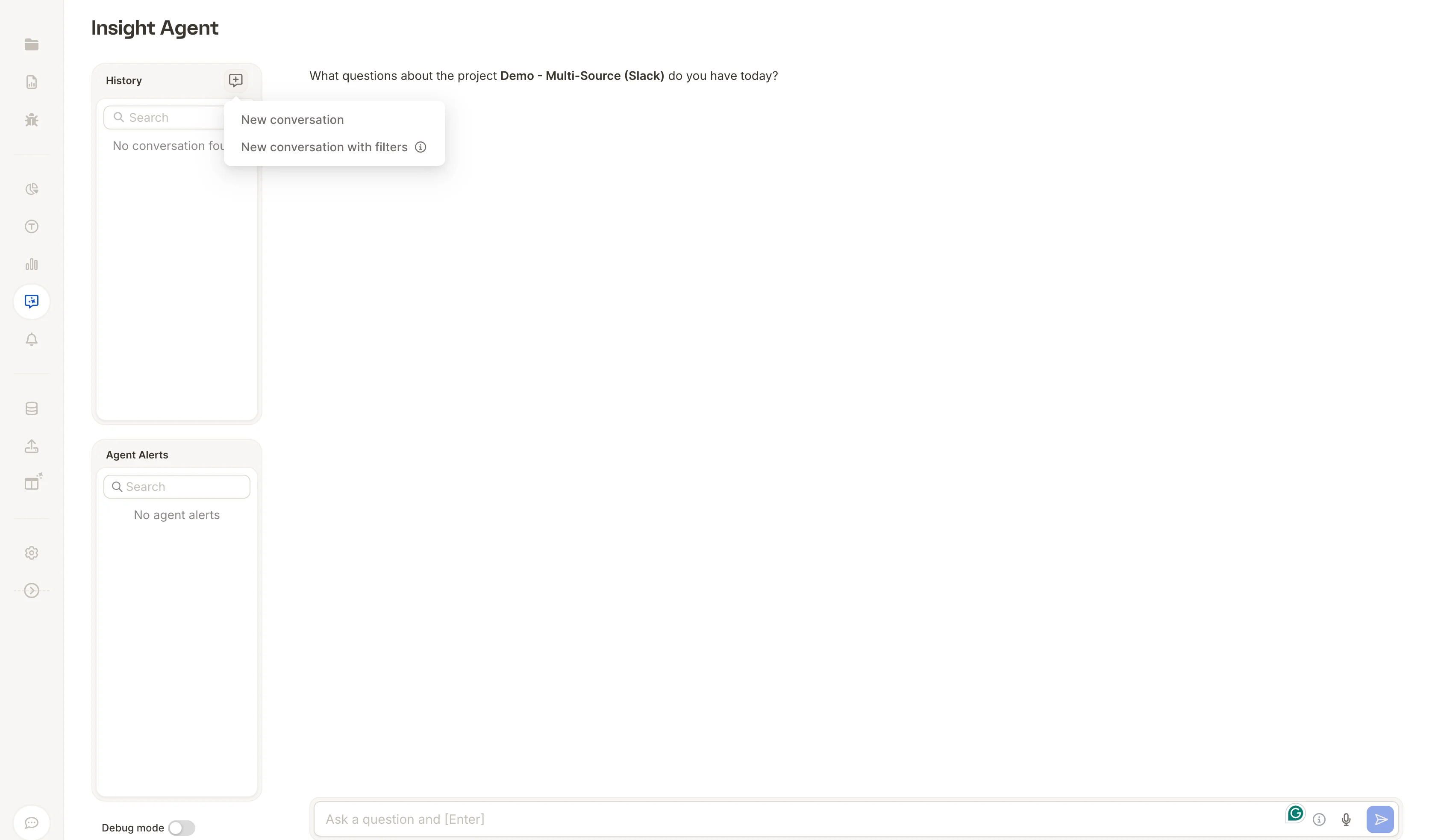
Once open, the Agent interface has two panels on the left:- History — search and revisit past conversations, or start a new one. Conversations are stored for 60 days.
- Agent Alerts — view any alerts triggered by the agent
Conversations are only visible where they were created. A chat you start on the project overview appears in that project’s history, while a chat you start on a specific report appears only in that report’s history. If you can’t find a past conversation, check that you’ve opened Agent from the same place where you originally created it.
- New conversation — start fresh with no filters
- New conversation with filters — narrow your analysis to a specific segment before you begin
Getting insights from your data
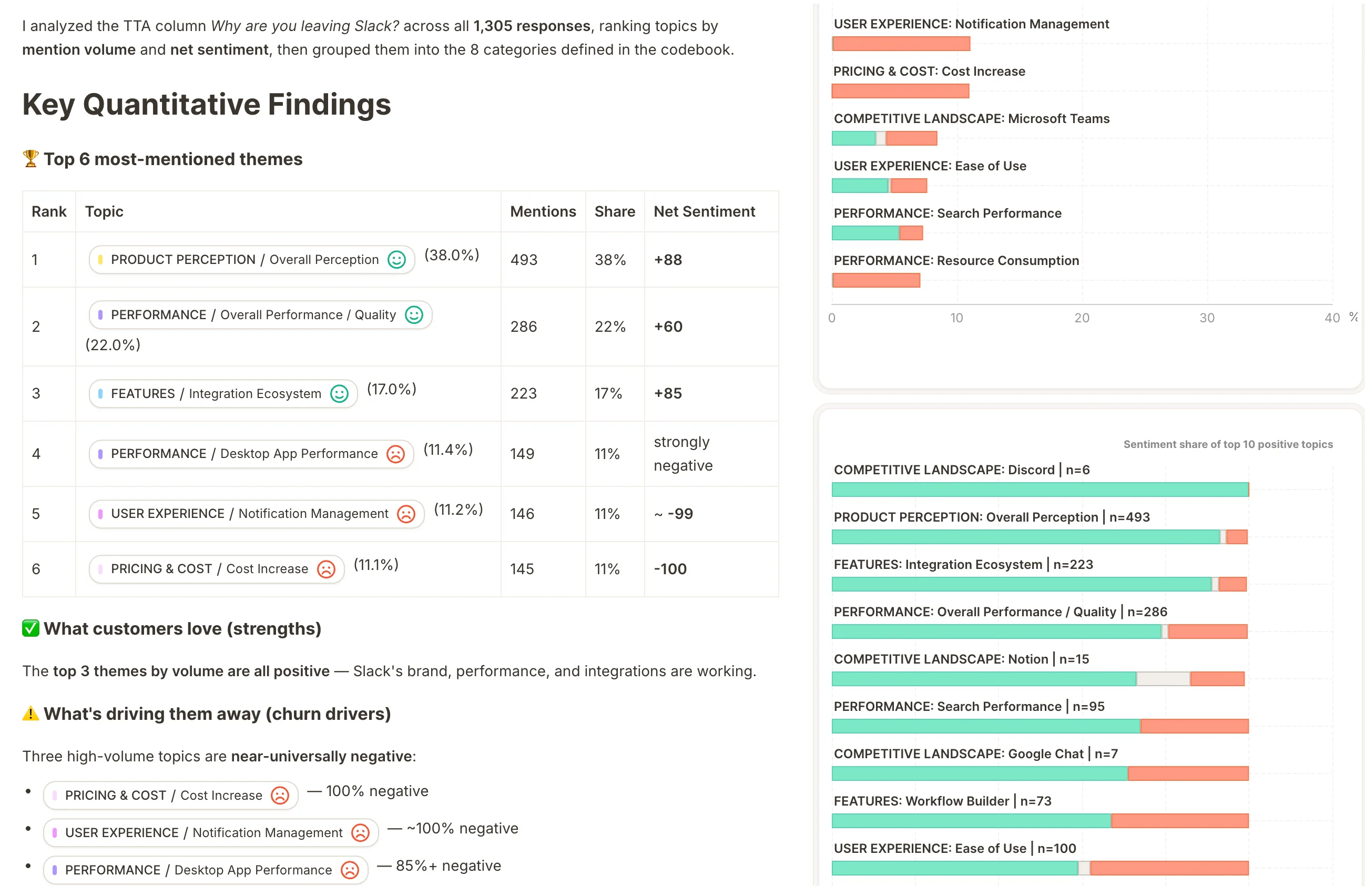
Agent is fully conversational — you drive the analysis by asking questions and following up to go deeper. There’s no fixed flow; the more context and direction you give, the sharper the output. A good way to get started:- Orient yourself — “What are the most common themes in this project?”
- Dig into something interesting — “Can you break down sentiment on delivery time by region?”
- Follow up — “Show me specific examples from customers who mentioned that negatively.”
Look up project details and individual rows
Agent can also answer questions about the project itself and find specific rows:- Project details: “What columns does this project have, and is translation turned on?”
- Individual rows: “Find the response from respondent ID 48213.” or “Show me the rows added since Monday.”
On a shared report view, Agent only looks up individual rows if the view allows row export. Columns hidden in the view are never returned.
Ask product and how-to questions
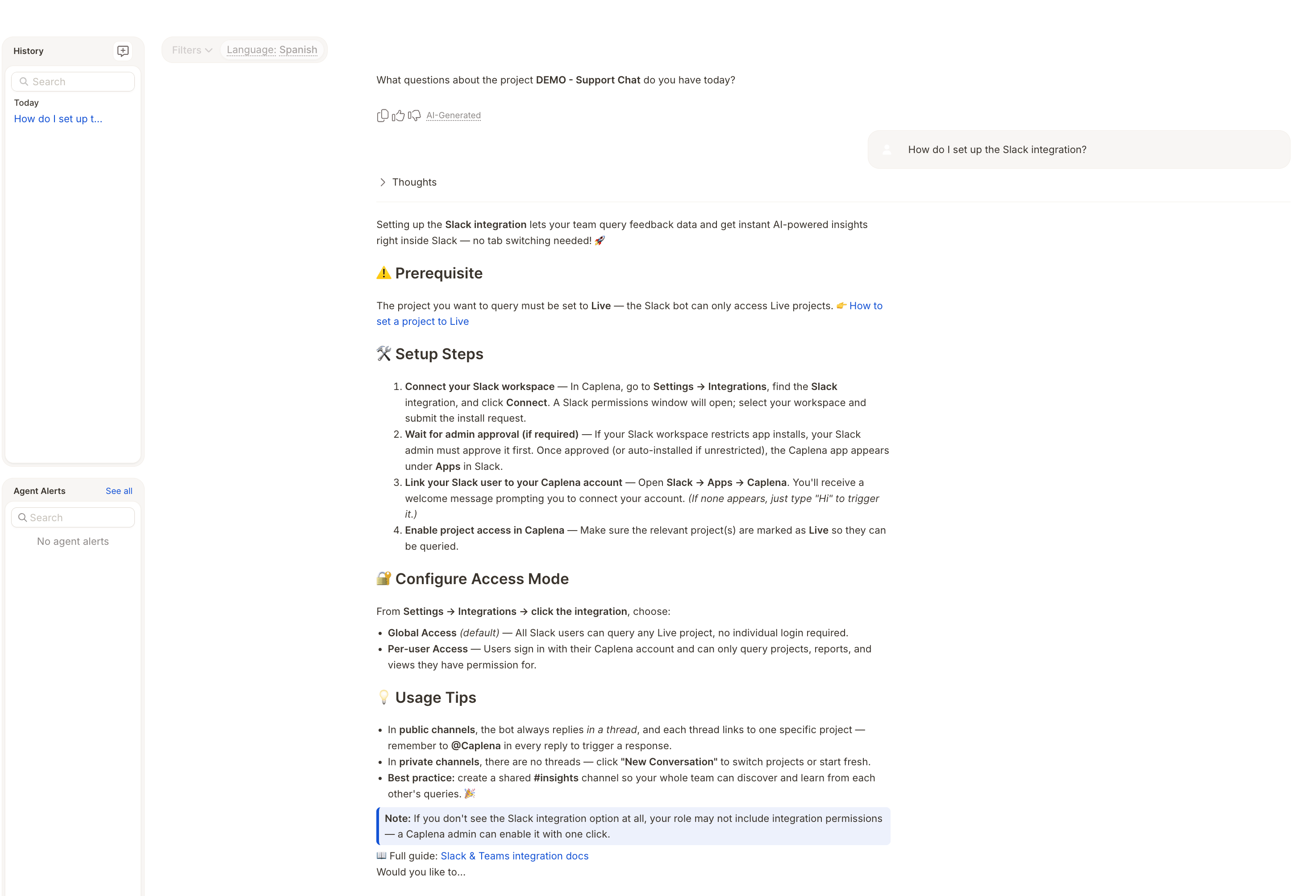
In addition to analyzing your data, Agent can answer questions about Caplena itself by pulling from the official Caplena documentation. Ask it things like:- “What’s a smart column and when should I use one?”
- “How do I share a filtered report with a stakeholder?”
- “What’s the difference between drivers and sentiment share?”
- “How do I set up the Slack integration?”
Create and edit Smart Columns from chat
Agent can build Smart Columns for you directly in the conversation — no need to leave the chat or write formulas yourself. Ask for a transformation in plain language and the agent will pick the right mode (mapping, formula, or LLM), draft the configuration, and preview the results before anything is saved live.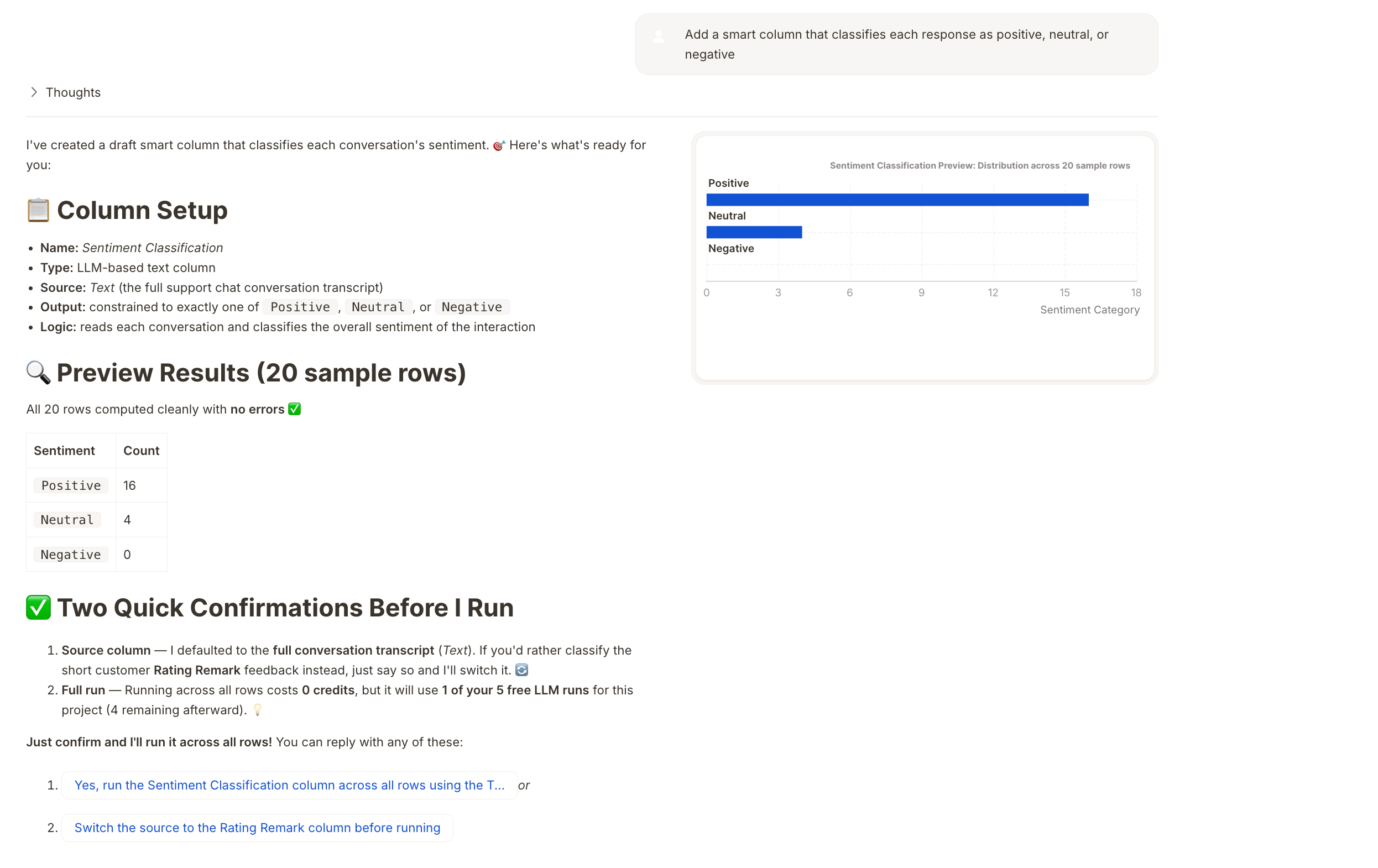
- Describe what you need — for example, “Add a column that classifies each response as positive, neutral, or negative” or “Create a column that extracts the brand mentioned in the feedback.”
- Review the preview — the agent runs the new column on a small set of rows so you can sanity-check the output before committing.
- Iterate if needed — refine the prompt (“Only flag complaints, not neutral mentions”) and the agent will update the draft and re-preview.
- Apply — once you confirm, the agent activates the column. For large projects, it can also run a free sample first so you can validate quality before consuming credits.
Editing a live Smart Column is a one-way action: once you confirm an edit, the column is updated immediately and cannot be reverted to a draft. The agent will always show you a preview and ask for confirmation first, and you can choose whether to apply the change to new rows only or recompute everything.
Understanding the insights
Insights highlight strengths (what customers value most) and weaknesses (recurring issues to address), based on topics with the highest positive and negative sentiment shares. Agent also surfaces driver analysis — showing how specific topics impact customer satisfaction.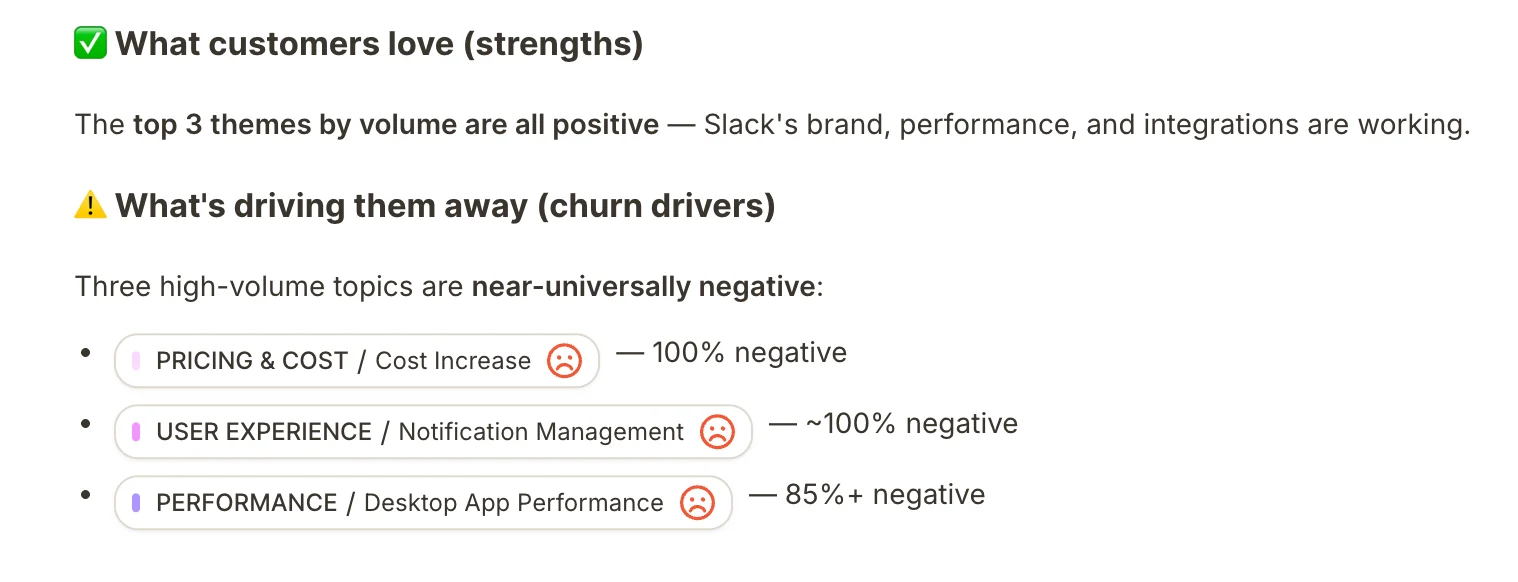
Use Agent in Slack or Microsoft Teams
You don’t have to be in Caplena to use Agent. With the Slack and Microsoft Teams integrations, your team can ask questions and get instant AI-powered answers directly in the tools they already use — no tab switching needed. Set up the Slack or Teams integration →Share Agent with stakeholders
When sharing a report, you can enable Agent for recipients so they can ask their own questions — scoped only to the filtered data you’ve shared with them. This lets stakeholders explore insights independently without accessing your full dataset. Learn how to share a filtered report with Agent →Usage limits
Each user can ask Agent up to 50 questions per day. The limit applies per user, not per organization or brand. The quota resets on a rolling 24-hour basis.Shortcut: the magic-wand icon
In a few places across Caplena, you’ll see a small magic-wand icon () next to the surrounding UI. Clicking it opens Agent with a prompt already filled in for that context — you can edit the prompt before sending, or send it as-is.
- AI quality score (Topic Assignment page) — pre-fills “Optimize the AI quality score” so the Topic Critique Agent can suggest description or structure changes that lift the score.
- Add topic button in the topic browser — pre-fills a request to suggest more topics for the selected category.
- Topic edit menu (title and description fields) — pre-fills a request to improve the assignment or description of that specific topic.
The magic-wand shortcuts are only visible to users on a plan that includes Conversational Insights (Agent access). Users without that entitlement won’t see the icon.