> ## Documentation Index
> Fetch the complete documentation index at: https://docs.caplena.com/llms.txt
> Use this file to discover all available pages before exploring further.
# Import, copy, and export your codebook
> Upload an existing codebook, reuse one from another project, or export your topic collection.
In Caplena, your codebook is called a **topic collection**: the categories, topics, codes, and descriptions used to analyze a text column. You might also know it as a *code frame*, *code plan*, or *coding scheme*.
This page covers the three ways to move a codebook in and out of Caplena:
| I want to… | Use | Where |
| - | - | - |
| Use a codebook I already have in a file | **Upload File** | When starting the analysis |
| Reuse a codebook from another Caplena project | **Import from another project** | When starting the analysis, or from the Topics tab |
| Get my codebook out of Caplena | **Topic summary** export | Export dialog in the Topics view |
## Import a codebook from a file
If you already have a list of codes, for example from a previous study or a client's coding scheme, you can upload it instead of letting the AI generate topics from scratch.
Put your codebook in a **CSV or Excel** file, one topic per row, using the column names below. A plain text list can't be imported directly. Paste it into Excel first, with one topic per row in a `topic` column.
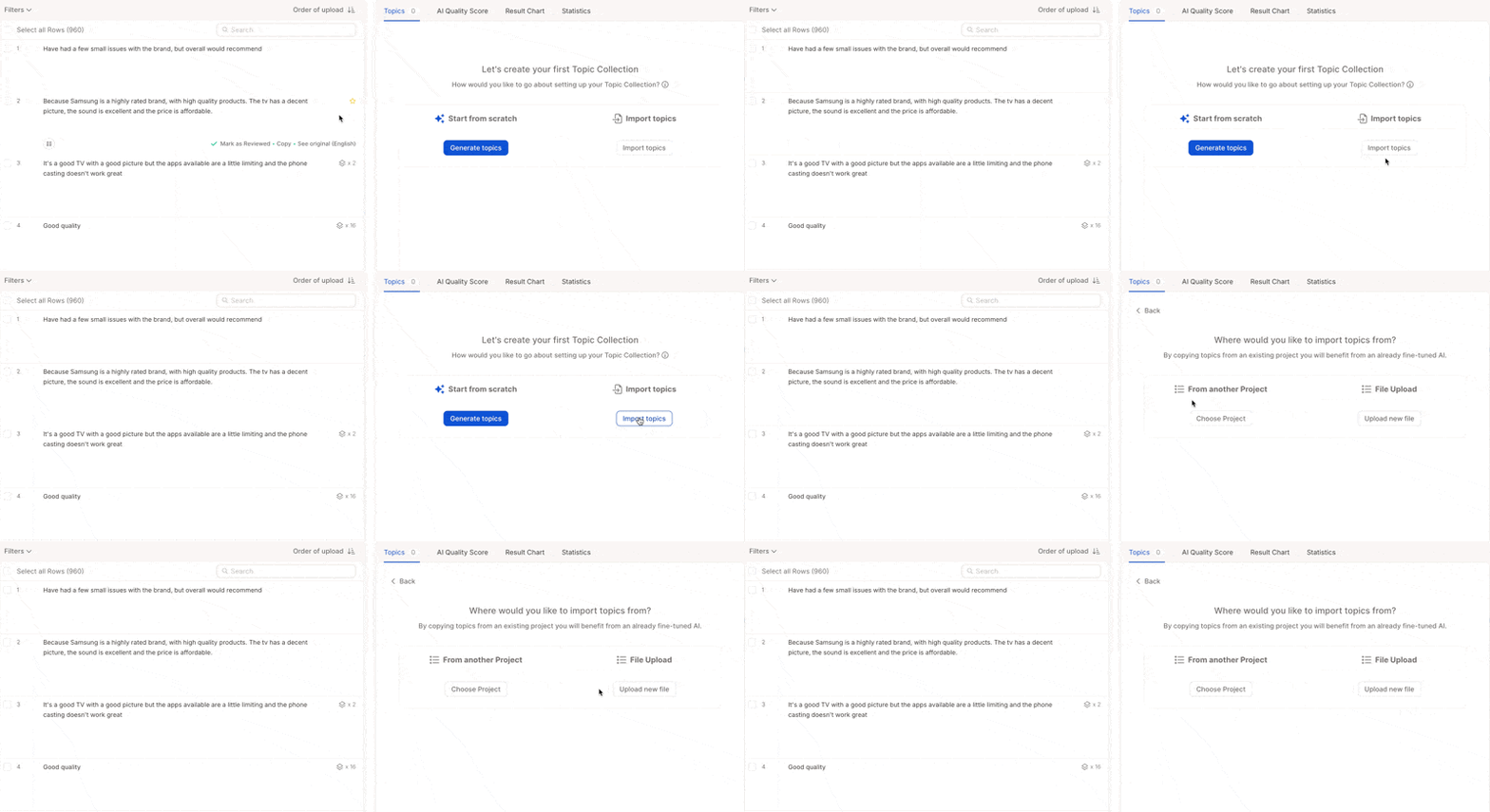
Open your project and click **Start analysis now** on the Overview panel.
**Choose how to start**, select **Import existing topics**, then **Upload File**, and upload your file.
 ### File format
| Column | Required | What it's for |
| - | - | - |
| `topic` | Yes | The topic name (label). |
| `category` | Yes | The category the topic belongs to. |
| `code` | No | A unique numerical ID for the topic. Use this to keep your existing code numbers. If you leave it out, Caplena assigns codes automatically. |
| `sentiment` | No | The sentiment setting for the topic. |
| `description` | No | When the topic should apply. The AI uses this as a primary input when assigning topics. |
| `keywords` | No | Comma-separated keywords, used in [Semi-Open mode](/get-started/starting-a-new-project/semi-open-mode-quick-guide) to match responses. Each keyword must be **30 characters or fewer**, including spaces. |
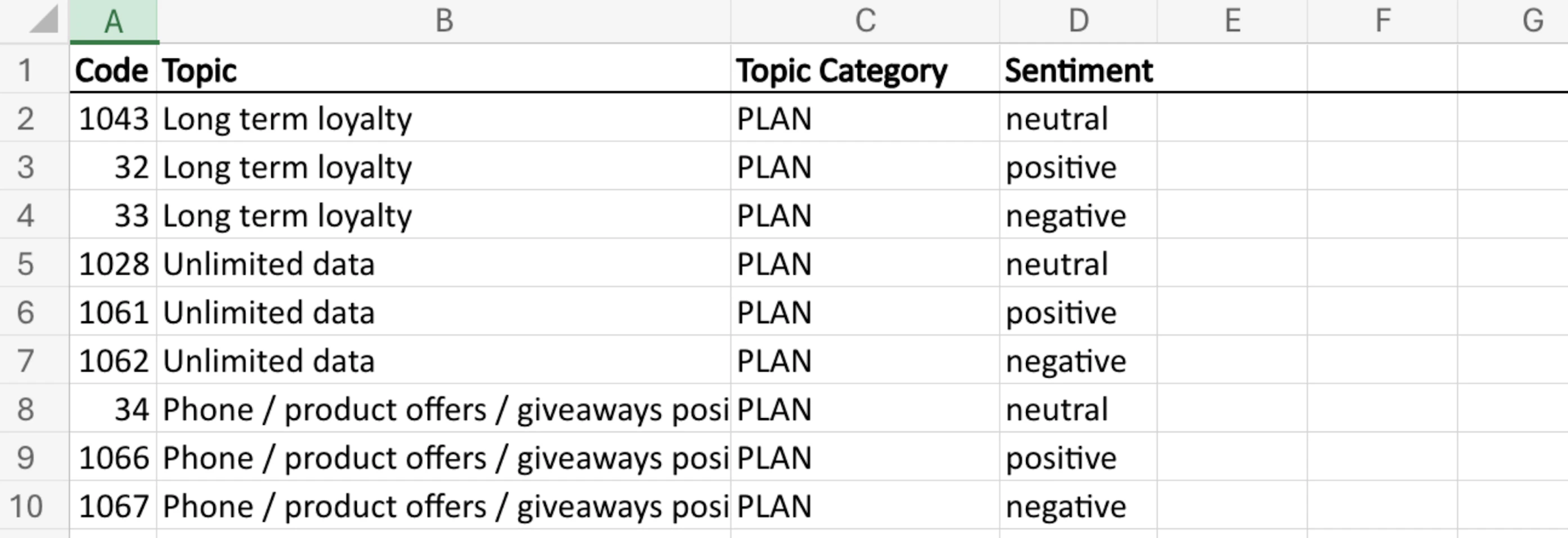
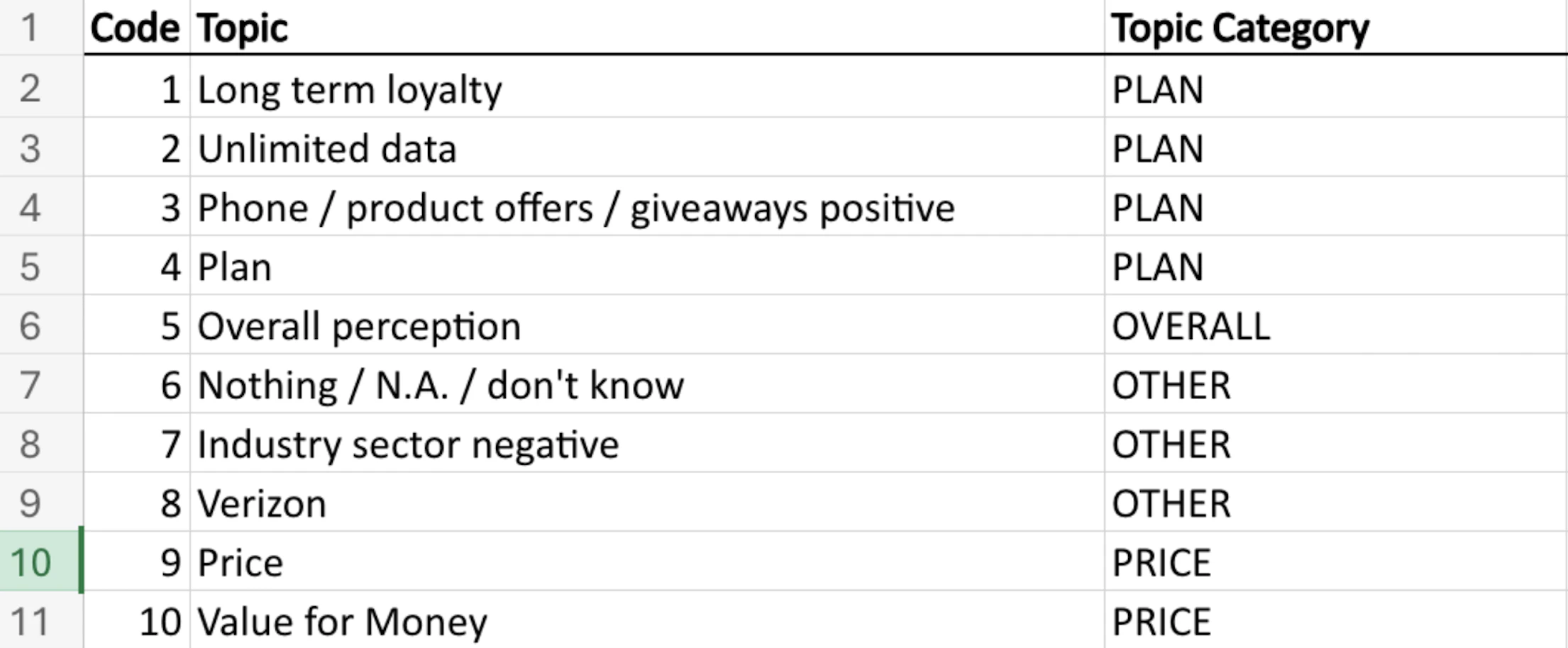
Your file must match one of these two layouts.
### File format
| Column | Required | What it's for |
| - | - | - |
| `topic` | Yes | The topic name (label). |
| `category` | Yes | The category the topic belongs to. |
| `code` | No | A unique numerical ID for the topic. Use this to keep your existing code numbers. If you leave it out, Caplena assigns codes automatically. |
| `sentiment` | No | The sentiment setting for the topic. |
| `description` | No | When the topic should apply. The AI uses this as a primary input when assigning topics. |
| `keywords` | No | Comma-separated keywords, used in [Semi-Open mode](/get-started/starting-a-new-project/semi-open-mode-quick-guide) to match responses. Each keyword must be **30 characters or fewer**, including spaces. |
Your file must match one of these two layouts.
 **Add descriptions if you can.** A topic like `Pricing` is assigned much more reliably with a description such as *"Mentions of cost, price, fees, or value for money, including comments about discounts and subscription tiers."* If the column is empty, Caplena generates descriptions on the first run, but your own keep assignments aligned with how your team defines each topic.
Imports with a keyword longer than 30 characters are rejected with an error. Shorten or split long keywords before uploading.
**You can upload an exported codebook as-is.** A [Topic summary export](#topic-summary-download-your-codebook) from another project can be uploaded directly, with no renaming or cleanup needed. Caplena matches the columns it needs and ignores the rest, such as colors and answer counts. This is an easy way to reuse a codebook across projects or accounts, or to edit it in Excel and bring it back.
## Reuse a codebook from another Caplena project
**Running the same survey again?** For recurring studies, such as quarterly NPS, yearly employee surveys, or a new wave of the same questionnaire, you usually don't need a second project. Keep everything in one project: [append the new rows](/data-project-management/adding-replacing-data/append-rows-to-an-existing-project) and add a [wave or year column](/data-project-management/common-smart-columns-intro/creating-a-helper-column-e.g.-wave-or-year) to tell the waves apart. The new responses are coded with the same codebook, and you can compare waves directly in your reports.
Reusing a codebook across projects makes sense when the projects really need to be separate, for example a different study that should use the same coding scheme, or a [DEV/PROD tracker setup](/topic-assignment/new-ai/tracker-setup). There is a way to do it.
In the project that needs the codebook, click **Start analysis now**.
Select **Import existing topics**, then **Other project**.
Choose the project and the text column whose codebook you want, then click **Inherit topic collection**.
Inheriting topics with the LLM model works best when the new dataset asks the same question in the same context. If the question wording or column context differs, review the inherited descriptions before running the AI. See [Learning Relationships Between Projects](/topic-assignment/understanding-the-basics/learning-relationships-between-projects-legacy-ai-vs-new-ai) for details.
## Export your codebook
### Topic summary (download your codebook)
The **Topic summary** export is how you download your codebook.
**Add descriptions if you can.** A topic like `Pricing` is assigned much more reliably with a description such as *"Mentions of cost, price, fees, or value for money, including comments about discounts and subscription tiers."* If the column is empty, Caplena generates descriptions on the first run, but your own keep assignments aligned with how your team defines each topic.
Imports with a keyword longer than 30 characters are rejected with an error. Shorten or split long keywords before uploading.
**You can upload an exported codebook as-is.** A [Topic summary export](#topic-summary-download-your-codebook) from another project can be uploaded directly, with no renaming or cleanup needed. Caplena matches the columns it needs and ignores the rest, such as colors and answer counts. This is an easy way to reuse a codebook across projects or accounts, or to edit it in Excel and bring it back.
## Reuse a codebook from another Caplena project
**Running the same survey again?** For recurring studies, such as quarterly NPS, yearly employee surveys, or a new wave of the same questionnaire, you usually don't need a second project. Keep everything in one project: [append the new rows](/data-project-management/adding-replacing-data/append-rows-to-an-existing-project) and add a [wave or year column](/data-project-management/common-smart-columns-intro/creating-a-helper-column-e.g.-wave-or-year) to tell the waves apart. The new responses are coded with the same codebook, and you can compare waves directly in your reports.
Reusing a codebook across projects makes sense when the projects really need to be separate, for example a different study that should use the same coding scheme, or a [DEV/PROD tracker setup](/topic-assignment/new-ai/tracker-setup). There is a way to do it.
In the project that needs the codebook, click **Start analysis now**.
Select **Import existing topics**, then **Other project**.
Choose the project and the text column whose codebook you want, then click **Inherit topic collection**.
Inheriting topics with the LLM model works best when the new dataset asks the same question in the same context. If the question wording or column context differs, review the inherited descriptions before running the AI. See [Learning Relationships Between Projects](/topic-assignment/understanding-the-basics/learning-relationships-between-projects-legacy-ai-vs-new-ai) for details.
## Export your codebook
### Topic summary (download your codebook)
The **Topic summary** export is how you download your codebook.
 The export also includes a **category overview** with the number and share of answers per category. An answer with several topics in the same category is counted once.
For topics with sentiment enabled, each sentiment variant (neutral, negative, positive) is a **separate row with its own code**. For example, `AI Topic Detection` might appear as codes 1 (neutral), 2 (negative), and 3 (positive). Keep this in mind when matching codes in SPSS or another tabulation tool.
Go to the **Topics view** and click **Export** (top right).
Click the **Topic summary** tab and choose a file type, for example Excel.
Click **Export**.
The export also includes a **category overview** with the number and share of answers per category. An answer with several topics in the same category is counted once.
For topics with sentiment enabled, each sentiment variant (neutral, negative, positive) is a **separate row with its own code**. For example, `AI Topic Detection` might appear as codes 1 (neutral), 2 (negative), and 3 (positive). Keep this in mind when matching codes in SPSS or another tabulation tool.
Go to the **Topics view** and click **Export** (top right).
Click the **Topic summary** tab and choose a file type, for example Excel.
Click **Export**.
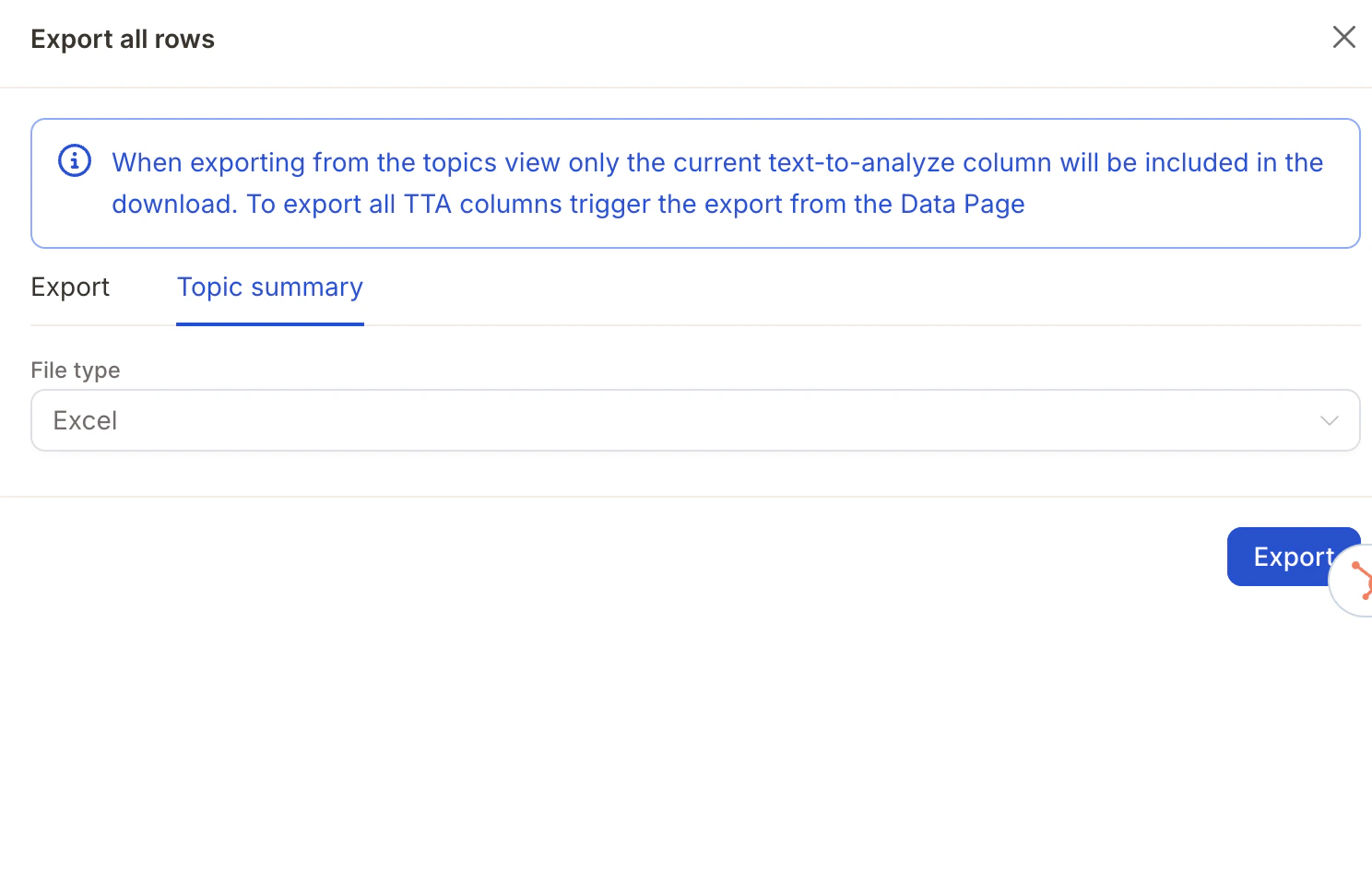 The Topic summary is exported **per topic collection**, so one text column at a time. If your project has several text columns, export the summary for each one.
## Common questions
Go to the **Topics view**, click **Export**, open the **Topic summary** tab, and export to Excel or CSV. You'll get every topic with its code, category, sentiment, description, and keywords. See [Topic summary](#topic-summary-download-your-codebook).
Yes. Export the [Topic summary](#topic-summary-download-your-codebook), make your changes in Excel, and upload the file through **Import existing topics → Upload File**. You don't need to rename or remove columns. Caplena picks up the ones it needs.
Yes. Include a `code` column in your upload file. You can also set codes manually on each topic. See [Code](/topic-assignment/understanding-the-basics/main-concepts-categories-topics-sentiment#code).
Not directly. Paste the list into Excel with one topic per row under a `topic` header, add `category` or other columns if you have them, and upload the file.
The simplest setup is one project for all waves. Append the new wave's rows to the existing project and add a wave or year column to tell them apart, so every wave uses the same codebook and you can compare them in one report. See [Append Rows to an Existing Project](/data-project-management/adding-replacing-data/append-rows-to-an-existing-project) and [Creating a Helper Column](/data-project-management/common-smart-columns-intro/creating-a-helper-column-e.g.-wave-or-year).
Yes, but importing a new codebook **restarts the analysis**, and topics are assigned again from scratch. Before you import, export the current [Topic summary](#topic-summary-download-your-codebook) so you have a copy of the existing codebook to go back to.
Use a separate test project and copy the codebook there, then copy it back once you're happy. See [Tracker Setup: Best Practices](/topic-assignment/new-ai/tracker-setup).
## Related pages
All the ways to create your first topic collection.
Categories, topics, codes, and sentiment explained.
Manage recurring studies with a DEV and PROD project.
All export formats for coded data.
This documentation is built and hosted on [Mintlify](https://mintlify.com), a developer documentation platform.
The Topic summary is exported **per topic collection**, so one text column at a time. If your project has several text columns, export the summary for each one.
## Common questions
Go to the **Topics view**, click **Export**, open the **Topic summary** tab, and export to Excel or CSV. You'll get every topic with its code, category, sentiment, description, and keywords. See [Topic summary](#topic-summary-download-your-codebook).
Yes. Export the [Topic summary](#topic-summary-download-your-codebook), make your changes in Excel, and upload the file through **Import existing topics → Upload File**. You don't need to rename or remove columns. Caplena picks up the ones it needs.
Yes. Include a `code` column in your upload file. You can also set codes manually on each topic. See [Code](/topic-assignment/understanding-the-basics/main-concepts-categories-topics-sentiment#code).
Not directly. Paste the list into Excel with one topic per row under a `topic` header, add `category` or other columns if you have them, and upload the file.
The simplest setup is one project for all waves. Append the new wave's rows to the existing project and add a wave or year column to tell them apart, so every wave uses the same codebook and you can compare them in one report. See [Append Rows to an Existing Project](/data-project-management/adding-replacing-data/append-rows-to-an-existing-project) and [Creating a Helper Column](/data-project-management/common-smart-columns-intro/creating-a-helper-column-e.g.-wave-or-year).
Yes, but importing a new codebook **restarts the analysis**, and topics are assigned again from scratch. Before you import, export the current [Topic summary](#topic-summary-download-your-codebook) so you have a copy of the existing codebook to go back to.
Use a separate test project and copy the codebook there, then copy it back once you're happy. See [Tracker Setup: Best Practices](/topic-assignment/new-ai/tracker-setup).
## Related pages
All the ways to create your first topic collection.
Categories, topics, codes, and sentiment explained.
Manage recurring studies with a DEV and PROD project.
All export formats for coded data.
This documentation is built and hosted on [Mintlify](https://mintlify.com), a developer documentation platform.